accessibility menu, dialog, popup

UserName

Retsch

Retsch


Die Philosophie von RETSCH basiert auf Kundenorientierung und Spitzentechnologie. Dies spiegelt sich in Geräten wider, deren hochwertige Komponenten auf ein perfektes Zusammenspiel ausgelegt sind. RETSCH-Produkte garantieren nicht nur repräsentative und reproduzierbare Ergebnisse bei der Mahlung und Partikelanalyse, sondern ermöglichen auch eine einfache und komfortable Bedienung.

Top-Kategorien


Ausgewählte Produkte

Verwandte Ressourcen

RETSCH Firmenvideo

RETSCH ist der führende Anbieter von Lösungen für die analysengerechte Probenvorbereitung und Charakterisierung von Feststoffen. Basierend auf über 100 Jahren an Erfahrung entwickelt RETSCH Zerkleinerungs- und Siebanlagen.

Ultra-Zentrifugalmühle ZM 300

Bietet maximale Mahlleistung bei einfacher Bedienung. Die variable Drehzahl von 6000 bis 23.000 U/min ermöglicht eine materialschonende, analysengerechte Probenvorbereitung in kürzester Zeit.

Schwingmühle MM 500 Vario

Vielseitiges Tischgerät, das ultimative Leistung mit maximaler Flexibilität für Ihren Probenvorbereitungsprozess bietet. Für die Trocken-, Nass- und Kryogenvermahlung von kleinen Probenmengen mit hohem Durchsatz.


Retsch Logo

Über RETSCH

Die Philosophie von RETSCH basiert auf Kundenorientierung und Spitzentechnologie. Dies spiegelt sich in Geräten wider, deren hochwertige Komponenten auf ein perfektes Zusammenspiel ausgelegt sind. RETSCH-Produkte garantieren nicht nur repräsentative und reproduzierbare Ergebnisse bei der Mahlung und Partikelanalyse, sondern ermöglichen auch eine einfache und komfortable Bedienung.

Alle Produkte

Gefilterte Suchergebnisse

Produkte von einigen unserer Lieferanten werden in den gefilterten Suchergebnissen nicht angezeigt. Bitte deaktivieren Sie alle Filter, um diese Produkte zu sehen.

Ergebnisse verfeinern

Ergebnisse verfeinern

  • (13)
  • (1)
  • (1)
  • (1)
  • (2)
  • (1,697)
  • (10)
  • (4)
  • (23)
  • (3)
  • (15)
  • (1)
  • (2)
  • (1)
  • (1)
  • (4)
  • (1)
  • (1)
  • (5)
  • (5)
  • (37)
  • (17)
  • (5)
  • (4)
  • (4)
  • (3)
  • (138)
  • (135)
  • (3)
  • (103)
  • (342)
  • (9)
  • (258)
  • (4)
  • (250)
  • (48)
  • (250)
  • (153)
  • (9)
  • (45)
  • (1,480)
  • (1)
  • (134)
  • (1,426)
  • (133)
  • (2)
  • (2)
  • (932)
  • (8)
  • (1)
  • (1)
  • (2)
  • (7)
  • (2)
  • (23)
  • (10)
  • (1)
  • (1)
  • (2)
  • (2)
  • (7)
  • (1)
  • (7)
  • (1)
  • (8)
  • (15)
  • (1)
  • (1)
  • (1)
  • (3)
  • (1)
  • (2)
  • (1)
  • (4)
  • (2)
  • (1)
  • (1)
  • (1)
  • (1)
  • (8)
  • (1)
  • (1)
  • (1)
  • (5)
  • (1)
  • (1)
  • (1)
  • (2)
  • (2)
  • (4)
  • (1)
  • (1)
  • (2)
  • (1)
  • (2)
  • (1)
  • (6)
  • (1)
  • (1)
  • (1)
  • (4)
  • (25)
  • (1)
  • (1)
  • (1)
  • (1)
  • (1)
  • (3)
  • (43)
  • (4)
  • (1)
  • (2)
  • (1)
  • (59)
  • (11)
  • (1)
  • (1)
  • (3)
  • (1)
  • (2)
  • (2)
  • (1)
  • (1)
  • (6)
  • (9)
  • (2)
  • (2)
  • (5)
  • (1)
  • (1)
  • (3)
  • (2)
  • (5)
  • (1)
  • (1)
  • (13)
  • (20)
  • (2)
  • (1)
  • (1)
  • (2)
  • (1)
  • (3)
  • (11)
  • (1)
  • (7)
  • (2)
  • (1)
  • (5)
  • (1)
  • (1)
  • (1)
  • (5)
  • (1)
  • (2)
  • (4)
  • (1)
  • (2)
  • (1)
  • (7)
  • (5)
  • (1)
  • (4)
  • (2)
  • (1)
  • (2)
  • (3)
  • (1)
  • (1)
  • (4)
  • (2)
  • (1)
  • (4)
  • (1)
  • (1)
  • (1)
  • (1)
  • (1)
  • (1)
  • (1)
  • (1)
  • (1)
  • (5)
  • (1)
  • (1)
  • (1)
  • (1)
  • (1)
  • (1)
  • (1)
  • (1)
  • (1)
  • (1)
  • (1)
  • (2)
  • (1)
  • (1)
  • (4)
  • (2)
  • (1)
  • (2)

Laboratory Mills, Grinders & Crushers

Labormühlen, Zerkleinerungsmaschinen und Brecher

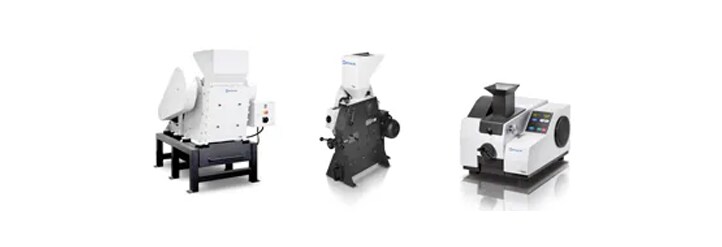
Für chemische und physikalische Analysemethoden wie AAS, NIR, ICP oder XRF ist es unerlässlich, dass die Probe perfekt auf einen ausreichenden analytischen Feinheitsgrad homogenisiert wird. Eine zuverlässige und genaue Analyse kann nur durch eine reproduzierbare Probenvorbereitung gewährleistet werden.

Für diese Aufgaben bietet RETSCH ein umfangreiches Programm an modernsten Mühlen und Brechern für die Grob-, Fein- und Feinstzerkleinerung nahezu aller Materialien. Die Auswahl an Mahlwerkzeugen und Zubehör stellt sicher, dass unsere Geräte eine kontaminationsfreie und zuverlässige Probenaufbereitung vor der Laboranalyse gewährleisten.

Retsch

Sieben

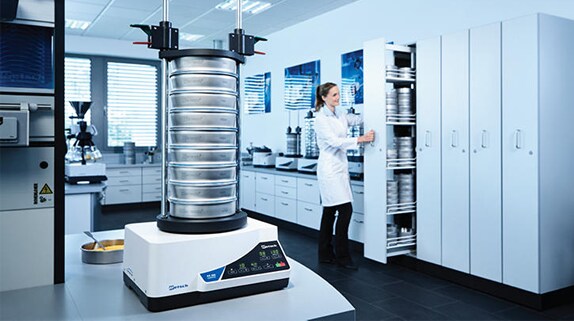
Partikelgrößenanalyse nach DIN EN ISO 9000 ff. Die Partikelgrößenverteilung beeinflusst die physikalischen und chemischen Eigenschaften von Feststoffen. Daher ist dieses Kriterium im Rahmen der Wissenschaft und Qualitätskontrolle von höchster Bedeutung.

Nur wenn die Größenverteilung konstant bleibt, kann eine gleichbleibende Produktqualität gewährleistet werden, wie die folgenden Beispiele zeigen:

  • die Festigkeit von Beton hängt von der Korngröße des Zements ab
  • der Geschmack von Schokolade wird durch die Feinheit des Kakaos beeinflusst
  • Fließverhalten und Löslichkeit von Waschpulvern hängen von der Feinheit und Kornform der Ausgangsstoffe ab

RETSCH Siebmaschinen, Analysensiebe und Auswertesoftware sind der Schlüssel zu einfachen, schnellen, reproduzierbaren und vor allem genauen Analysen.

Besondere Angebote

Ressourcen

RETSCH’s philosophy is based on customer orientation and leading edge technology.

Filename
17557_brochure_catalogue_general_en.pdf
Size
13 MB
Format
application/pdf

First class product quality thanks to advanced manufacturing methods, this is reflected in instruments whose high-quality components are designed for perfect interaction.

Filename
17557_brochure_overview_en.pdf
Size
3 MB
Format
application/pdf

An expert guide to neutral-to-analysis size reductionand homogenization in the laboratory.

Filename
17557_expert_guide_milling_en.pdf
Size
1 MB
Format
application/pdf

Taking a close look at quality: an expert guide to particle size analysis.

Filename
17557_expert_guide_sieving_en.pdf
Size
2 MB
Format
application/pdf

The determination and knowledge of the particle size distribution is an essential part of the quality control process for industrial products. Easy handling, low investment cost and high accuracy make sieve analysis one of the most frequently used procedures for measuring the particle size. This white paper gives an overview of the different sieving techniques and describes the necessary steps to ensure reliable results.

Filename
17557_more_resources_1.pdf
Size
716 KB
Format
application/pdf

A solid sample material should always be sufficiently prepared by size reduction and homogenization before it is subjected to chemical or physical analysis. Care should be taken that the analysis sample fully represents the original material and that the sample preparation process is carried out reproducibly. Most sample materials can be reduced to the required analytical fineness at room temperature by choosing a mill with a suitable size reduction principle (impact, pressure, friction, shearing, cutting).

Filename
17557_more_resources_2.pdf
Size
525 KB
Format
application/pdf

Modern analytical methods increase precision and push detection limits to make even the smallest traces of sample components detectable. Despite this development sample preparation, which is carried out prior to the actual analysis, is frequently neglected. Errors caused by lacking accuracy in sample preparation have a much bigger impact than errors made during analysis.

Filename
17557_more_resources_3.pdf
Size
1020 KB
Format
application/pdf

Biological samples exist in all shapes and sizes: hard bones, tough and fibrous plants, tough and viscous sputum, soft muscles, tumor or liver tissue. Not to mention the millions of cells such as yeast, bacteria or algae, which have to be disrupted for applications such as DNA or RNA isolation or protein extraction. Retsch offers a range of mills and grinders for easy and reproducible pulverization of solid sample materials some of which are also suitable for cell disruption and homogenization of biological sample materials.

Filename
17557_more_resources_4.pdf
Size
1 MB
Format
application/pdf

Food occurs in a great variety of consistencies and is often inhomogeneous. Food testing labs require representative samples to produce meaningful and reproducible analysis results. Therefore, food samples must be homogenized and pulverized to the required analytical fineness, ideally with as little time and effort as possible.

Filename
17557_more_resources_5.pdf
Size
878 KB
Format
application/pdf

How are nano particles produced? The “Bottom-Up” method synthesizes particles from atoms or molecules. The “Top-Down” method involves reducing the size of larger particles to nanoscale, for example with laboratory mills. Nano particles are produced by colloidal grinding which involves dispersion of the particles in liquid to neutralize the surface charges. Factors such as energy input and size reduction principle make ball mills the best choice for the production of nanoparticles.

Filename
17557_more_resources_6.pdf
Size
994 KB
Format
application/pdf

Nothing matches the performance of the original! RETSCH's Ultra Centrifugal Mills set standards in sample homogenization with more than 20,000 installations world-wide. The outstanding performance, flexibility, user-friendliness and robustness of this highspeed rotor mill make it the undisputed leader in its class.

Filename
17557_more_resources_7.pdf
Size
411 KB
Format
application/pdf