missing translation for 'onlineSavingsMsg'
Learn More
Learn More

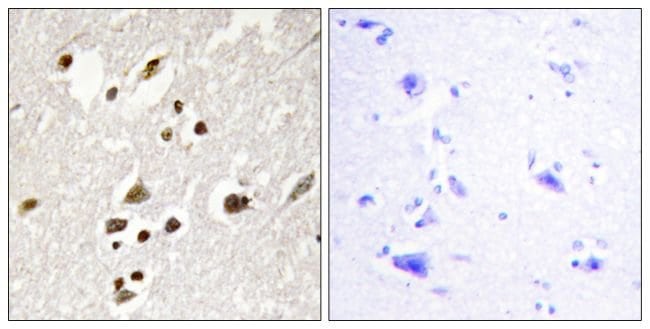
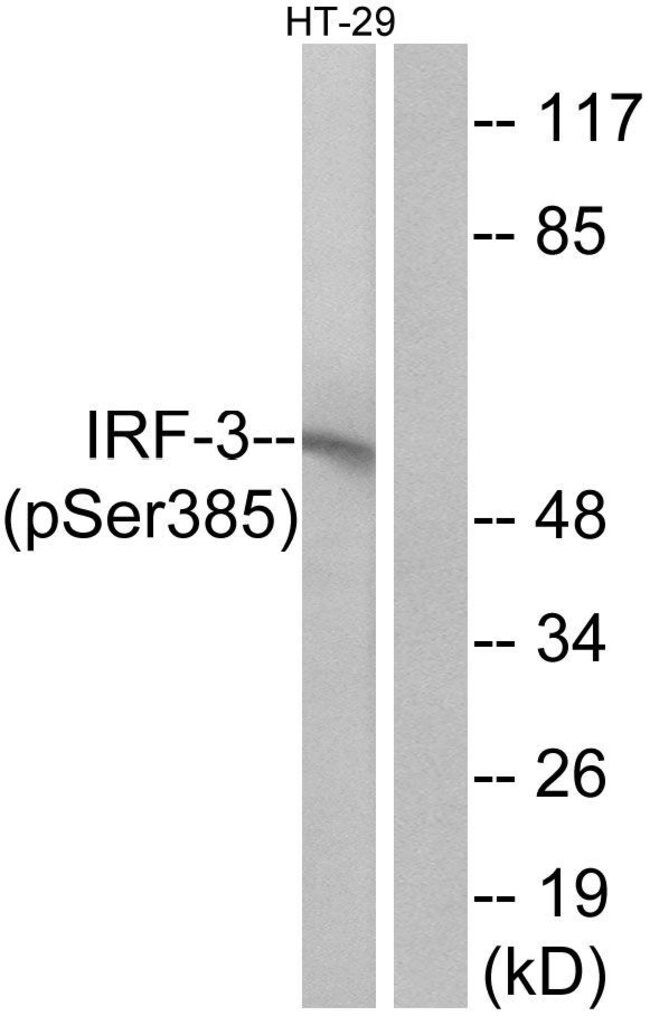
Phospho-IRF3 (Ser385) Polyclonal Antibody, Invitrogen™
Beschreibung
IRF-3 can inhibit cell growth and plays a critical role in controlling the expression of genes in the innate immune response. In unstimulated cells, IRF-3 is present in the cytoplasm. Viral infection results in phosphorylation of IRF-3 and leads to its translocation to the nucleus where it activates promoters containing IRF-3-binding sites. Phosphorylation of IRF-3 occurs at a cluster of C-terminal Ser and Thr residues (between 385 and 405), leading to its association with the p300/CBP coactivator protein that promotes DNA binding and transcriptional activity. During infection, IRF-3 is likely activated through a pathway that includes activation of Toll-like receptors and a kinase complex that includes IKK epsilon and TBK1. IRF-3 is phosphorylated at Ser396 following viral infection, expression of viral nucleocapsid, and double-stranded RNA treatment. These events likely play a role in activation of IRF-3.

Spezifikation
Spezifikation
| Antigen | Phospho-IRF3 (Ser385) |
| Anwendungen | Immunocytochemistry, Immunofluorescence, Immunohistochemistry (Paraffin), Western Blot |
| Klassifikation | Polyclonal |
| Konzentration | 1 mg/mL |
| Konjugat | Unconjugated |
| Zusammensetzung | Dulbecco′s PBS with 150mM NaCl, 50% glycerol and 0.02% sodium azide; pH 7.4 |
| Gen | IRF3 |
| Gen-Zugriffsnummer | Q14653, P70671 |
| Gen-Alias | IRF3, IRF-3, IRF3, Interferon regulatory factor 3 |
| Gensymbole | IRF3 |
| Mehr anzeigen |
Name des Produkts
Indem Sie auf Absenden klicken, erklären Sie sich damit einverstanden, dass Fisher Scientific sich mit Ihnen in Verbindung setzen kann, um Ihr Feedback in diesem Formular zu bearbeiten. Wir werden Ihre Informationen nicht für andere Zwecke weitergeben. Alle bereitgestellten Kontaktinformationen werden in Übereinstimmung mit unserer Datenschutzrichtlinie aufbewahrt. Datenschutzrichtlinie.
Haben Sie Verbesserungsvorschläge?