missing translation for 'onlineSavingsMsg'
Learn More
Learn More

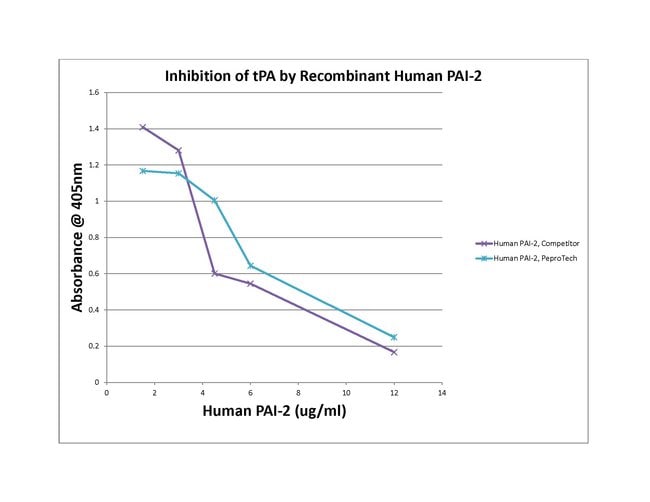
Gibco™ Human PAI-2 Recombinant Protein, PeproTech®
Click to view available options
Menge:
10 μg
100 μg
2 μg
2 x 500 μg
250 μg
500 μg
Packungsgröße:
1 Milligramm
10 Mikrogramm
100 Mikrogramm
2 Mikrogramm
2 Stück
250 Mikrogramm
500 Mikrogramm
Beschreibung
140-06-1MG will be provided as 2 x 500 μg (140-06-500UG). Recombinant Human PAI-2 is a 46.5 kDa, nonglycosylated protein of 415 residues. This product is shipped at ambient temperature. For storage, handling and reconstitution information, please see the lot-specific Certificate of Analysis
PAI-2 is an inhibitory serpin expressed mainly in keratinocytes, activated monocytes, and placental trophoblasts. It exists predominantly as a 47 kDa, nonglycosylated, intracellular protein, which can be induced to be secreted as 60 kDa glycoprotein. The glycosylated and unglycosylated forms of PAI-2 are equally effective as inhibitors of urokinase-type plasminogen activator (uPA), the only established physiological target of this serpin. PAI-2 has a unique ability to form dormant polymers spontaneously and reversibly under physiological conditions. The physiological relevance of this property, which is neither a consequence of any mutation in the PAI-2 gene nor associated with any known disorder, is still unclear. However, it appears that the formation of intracellular, dormant polymers may be important for the controlled release of the inhibitor from PAI-2 producing cells. Plasma levels of PAI-2 are usually low or undetectable, except during pregnancy and in some forms of monocytic leukemia. Secretion of PAI-2 from the placenta normally occurs during the third trimester of pregnancy, and accounts for the dramatic increase in PAI-2 levels (up to 250 ng/ml), which are maintained at these levels until postpartum, and then rapidly decline. In addition to its vital role in protecting the placenta from degradation by uPA and/or uPA-activated proteases, PAI-2 has been shown to be essential for the prevention of metastatic spread of neck, lung and breast cancers. The beneficial effect of PAI-2 seen in these studies is presumed to stem from its ability to inhibit uPA-dependent cell dissemination. PAI-2 has also been reported to inhibit keratinocyte proliferation, and to participate in the innate immune response during viral infection.

Spezifikation
Spezifikation
| Zugriffsnummer | P05120 |
| Zur Verwendung mit (Anwendung) | Control, Bioactivity |
| Zusammensetzung | Protein with no preservative |
| Gen-ID (Entrez) | 5055 |
| Molekulargewicht | 46.5 kDa |
| Name | Human PAI-2 |
| Reinigungsverfahren | Purified |
| Menge | 100 μg |
| Quelle | E. coli |
| Lagerungsbedingungen | -20°C |
| Mehr anzeigen |
Berichtigung von Produktinhalten
Bitte geben Sie uns Ihr Feedback zu den Produktinhalten, indem Sie das folgende Formular ausfüllen.
Name des Produkts
Haben Sie Verbesserungsvorschläge?Übermitteln Sie eine inhaltliche Korrektur