missing translation for 'onlineSavingsMsg'
Learn More
Learn More
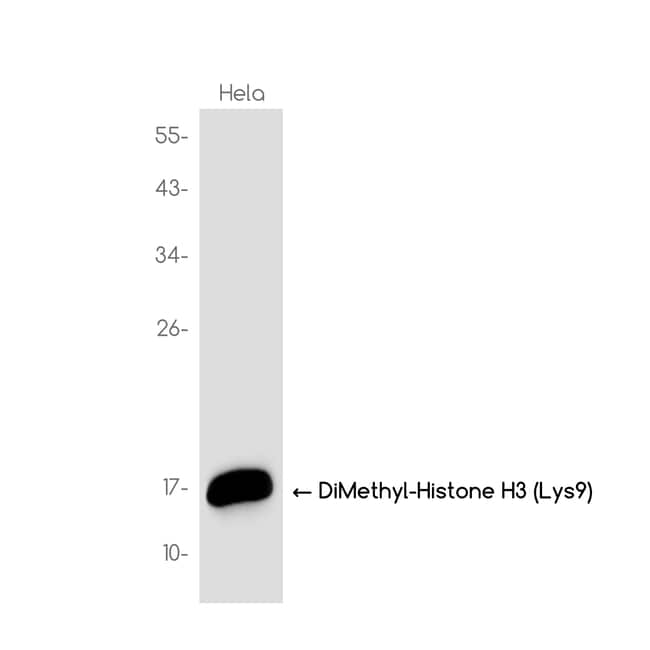
Invitrogen™ H3K9me2 Recombinant Rabbit Monoclonal Antibody (K01_3J91)
Description
H3K9me2 Recombinant Monoclonal Antibody for Western Blot
Histone H3 is one of the DNA-binding proteins found in the chromatin of all eukaryotic cells. H3 along with four core histone proteins binds to DNA forming the structure of the nucleosome. Histones play a central role in transcription regulation, DNA repair, DNA replication and chromosomal stability. Post translationally, histones are modified in a variety of ways to either directly change the chromatin structure or allow for the binding of specific transcription factors. The N-terminal tail of histone H3 protrudes from the globular nucleosome core and can undergo several different types of post-translational modification that influence cellular processes. These modifications include the covalent attachment of methyl or acetyl groups to lysine and arginine amino acids and the phosphorylation of serine or threonine.

Specifications
Specifications
| Antigène | H3K9me2 |
| Applications | Western Blot |
| Classification | Recombinant Monoclonal |
| Clone | K01_3J91 |
| Concentration | 1 mg/mL |
| Conjugué | Unconjugated |
| Formule | 50mM tris glycine with 0.05% BSA, 40% glycerol, 150mM NaCl and 0.01% sodium azide; pH 7.4 |
| Expression | H3C1 |
| Numéro d’ordre du gène | P68431, Q71DI3 |
| Alias de gène | CG31613; CG31613-PA; CG33803; CG33806; CG33809; CG33812; CG33815; CG33818; CG33821; CG33824; CG33827; CG33830; CG33833; CG33836; CG33839; CG33842; CG33845; CG33848; CG33851; CG33854; CG33857; CG33860; CG33863; CG33866; Di histone H3/c; dimethyl H3; di-methyl H3; Dimethyl Histone H3; di-methyl histone H3; Di-Methyl-H3 K9; Di-Methyl-H3 Lys9; Di-Methyl-Histone H3 K9; Di-Methyl-Histone H3 Lys9; Dmel\CG31613; Dmel_CG31613; h3; H3 histone; H3 histone family, member A; H3 histone family, member I; H3 histone family, member K; H3 histone family, member L; H3 histone family, member M; H3 histone, family 2; H3 histone, family 3A; H3 histone, family 3B; H3 histone, family 3B (H3.3B); H3 histone, family 3C; H3 K9me2; H3.1-221; H3.1-291; H3.1-I; H3.2; H3.2-221; H3.2-614; H3.2-615; H3.2-616; h3.2a; H3.3A; H3.3B; H3.5; H3/A; H3/b; H3/d; H3/f; H3/i; H3/j; H3/k; H3/l; H3/M; H3/n; H3/o; H3-143; H3-291; H3-3A; H3-3b; H3-53; H3-614; H3a; H3b; H3-B; H3c1; H3C10; H3C11; H3C12; H3C2; H3C3; H3C4; H3C6; H3C7; H3C8; H3f; H3-F; H3F1K; H3F2; H3F3; H3F3A; H3f3b; H3F3C; H3FA; H3FB; H3FC HIST1H3C; H3FD; H3FF; H3FH; H3FI; H3FJ; H3FK; H3FL; H3FM; H3FN; H3g; H3h; H3i; H3K9; H3Lys9me2; h3r; His3; His3:CG31613; His3:CG31613-PA; His3:CG33803; His3:CG33806; His3:CG33809; His3:CG33812; His3:CG33815; His3:CG33818; His3:CG33821; His3:CG33824; His3:CG33827; His3:CG33830; His3:CG33833; His3:CG33836; His3:CG33839; His3:CG33842; His3:CG33845; His3:CG33848; His3:CG33851; His3:CG33854; His3:CG33857; His3:CG33860; His3:CG33863; His3:CG33866; Hist1; HIST1H3A; HIST1H3B; Hist1h3c; Hist1h3d; HIST1H3E; Hist1h3f; Hist1h3g; hist1h3g.L; Hist1h3h; HIST1H3I; HIST1H3J; hist2h3; HIST2H3A; Hist2h3b; HIST2H3C; Hist2h3c1; Hist2h3c2; Hist2h3c2-ps; Hist2h3ca1; Hist2h3ca2; HIST2H3D; histone 1, H3a; histone 1, H3b; histone 1, H3f; histone 1, H3h; histone 2, H3a; histone 2, H3c; histone 2, H3c2; histone 2, H3ca2; Histone 3; histone cluster 1, H3a; histone cluster 1, H3b; histone cluster 1, H3f; histone cluster 1, H3g protein L homeolog; histone cluster 1, H3h; histone cluster 2, H3a; histone cluster 2, H3c; histone cluster 2, H3c2; histone cluster 2, H3c2, pseudogene; histone gene complex 1; histone H3; Histone H3.1; histone H3.2; Histone H3.3; histone H3.3C; Histone H3.5; histone H3/a; Histone H3/b; Histone H3/c; Histone H3/d; Histone H3/f; Histone H3/h; Histone H3/i; Histone H3/j; Histone H3/k; histone H3/l; Histone H3/m; histone H3/o; Histone H3K9; Histone H3K9me2; histone variant H3.5; M32461; methyl Histone 3; methyl Histone H3; PP781; XELAEV_18028537mg |
| Show More |
Product Title
By clicking Submit, you acknowledge that you may be contacted by Fisher Scientific in regards to the feedback you have provided in this form. We will not share your information for any other purposes. All contact information provided shall also be maintained in accordance with our Privacy Policy.
Spot an opportunity for improvement?