missing translation for 'onlineSavingsMsg'
Learn More
Learn More
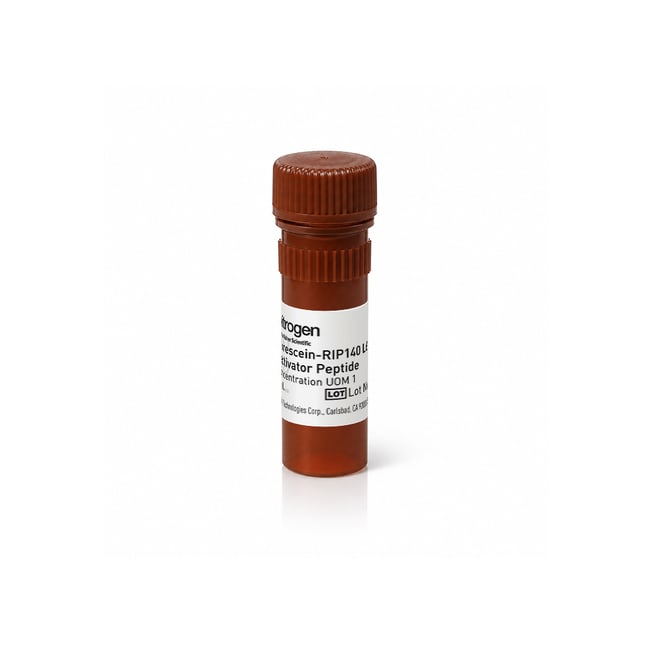
Invitrogen™ FL - RIP140L6 Peptide, 100μM
Descrizione
LanthaScreen™ fluorescent nuclear receptor coregulator peptides contain known interaction motifs and are labeled with fluorescein. These peptides are matched and validated to complement the LanthaScreen™ TR-FRET Nuclear Receptor Coregulator Assays. Assays developed using these reagents enable primary or secondary screening of nuclear receptor agonists and/or antagonists.
How they work
Ligand binding to nuclear receptors causes conformational changes in the receptor, resulting in a cascade of events, including dissociation of repressor proteins, association of coactivator proteins, and assembly of pol II and other transcriptional factors for activation of target genes. TR-FRET based assays can be developed using the LanthaScreen™ panel of fluorescein-labeled coregulator peptides to investigate conformational changes of nuclear receptors upon ligand binding, either by determining the affinity of ligand-bound receptor for different coregulator peptides, or by identifying additional agonists or antagonists via displacement or recruitment of a specific coregulator peptide. In the LanthaScreen™ TR-FRET RXR beta Coactivator Assay, a terbium (Tb)-labeled anti-GST antibody is used to indirectly label GSTtagged RXR beta protein. An agonist (9-cis Retinoic Acid) added to the receptor which, upon ligand binding, causes a conformational change resulting in recruitment of the Fl-D22 coactivator peptide (Figure 1). The binding of the fluorescent coregulator peptide to RXR beta causes an increase in the TR-FRET emission ratio (Figure 2).
Contents and Storage:
LanthaScreen™ fluorescent nuclear receptor coregulator peptides are supplied as 100μM solutions in peptide-appropriate buffers. Store peptides at -20°C.

Specifica
Specifica
| Content And Storage | Store in freezer (-5 to -30°C). |
| Tipo di etichetta | Classic Dyes |
| Quantità | 100 μL |
| Shipping Condition | Dry Ice |
For Research Use Only. Not for use in diagnostic procedures.
Titolo del prodotto
Facendo clic su Invia, l'utente riconosce che potrebbe essere contattato da Fisher Scientific in merito al feedback fornito in questo modulo. Non condivideremo le vostre informazioni per altri scopi. Tutte le informazioni di contatto fornite saranno conservate in conformità con la nostra Politica sulla privacy. Informativa sulla privacy.
Individuate un'opportunità di miglioramento?