missing translation for 'onlineSavingsMsg'
Learn More
Learn More
Codice prodotto.
17200124
Fornitore
Invitrogen™
N. del fornitore
PA5117621
-

558.00 CHF
479.88 CHF / 100 Mikroliter
Sparen 78.12 CHF
14% Rabatt
Deve Accedi o registrarsi per acquistare questo articolo.
Articolo soggetto a restrizioni
Verfügbar ab: 03-12-2026
Loggen Sie sich ein, um den Lagerbestand zu sehen
Loggen Sie sich ein, um den Lagerbestand zu sehen
Descrizione
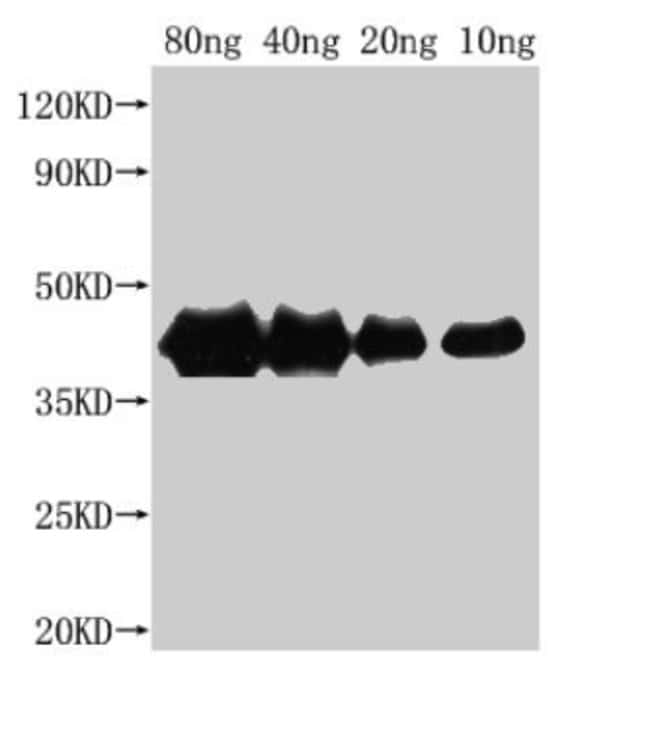
This antibody has been tested in direct-ELISA.
A DNA-binding protein implicated in transcriptional repression (silencing) (PubMed:333393, PubMed:2128918, PubMed:8890170, PubMed:8913298, PubMed:9398522, PubMed:16963779, PubMed:17046956, PubMed:23543115). Also involved in bacterial chromosome organization and compaction (PubMed:6379600, PubMed:10982869, PubMed:21903814). H-NS binds tightly to AT-rich dsDNA and inhibits transcription (PubMed:2512122, PubMed:16963779, PubMed:17435766, PubMed:17881364, PubMed:23543115). Binds upstream and downstream of initiating RNA polymerase, trapping it in a loop and preventing transcription (PubMed:11714691). Binds to hundreds of sites, approximately half its binding sites are in non-coding DNA, which only accounts for about 10% of the genome (PubMed:16963779, PubMed:17046956, PubMed:23543115). Many of these loci were horizontally transferred (HTG); this offers the selective advantage of silencing foreign DNA while keeping it in the genome in case of need (PubMed:17046956, PubMed:17881364, PubMed:26789284). Suppresses transcription at many intragenic sites as well as transcription of spurious, non-coding RNAs genome-wide (PubMed:24449106). Repression of HTG by H-NS is thought to allow their DNA to evolve faster than non-H-NS-bound regions, and facilitates integration of HTG into transcriptional regulatory networks (PubMed:26789284). A subset of H-NSStpA-regulated genes also require Hha (andor Cnu, ydgT) for repression; Hha and Cnu increase the number of genes DNA bound by H-NSStpA and may also modulate the oligomerization of the H-NSStpA-complex (PubMed:23543115). The protein forms 2 clusters in the nucleoid which gather hns-bound loci together, bridging non-contiguous DNA, and causes DNA substantial condensation (PubMed:21903814). Binds DNA better at low temperatures than at 37 degrees Celsius; AT-rich sites nucleate H-NS binding, further DNA-binding is cooperative and this cooperativity decreases with rising temperature (PubMed:17435766, PubMed:17881364). Transcriptional repression can be inhibited by dominant-negative mutants of StpA or itself (PubMed:8755860). May effect transcriptional elongation (PubMed:25638302). Can increase translational efficiency of mRNA with suboptimal Shine-Dalgarno sequences (PubMed:20595230). Plays a role in the thermal control of pili and adhesive curli fimbriae production, by inducing transcription of csgD (PubMed:17010156). Plays a role in flagellar function (PubMed:11031114). Represses the CRISPR-cas promoters, permits only weak transcription of the crRNA precursor; its repression is antagonized by LeuO (PubMed:20132443, PubMed:20659289). Binds preferentially to the upstream region of its own gene recognizing two segments of DNA on both sides of a bend centered around -150 (PubMed:7934818). Overexpression suppresses secY24, a temperature-sensitive mutation (PubMed:1537791). Has also been reported to activate transcription of some genes (PubMed:4566454, PubMed:338303, PubMed:2128918).

Specifica
Specifica
| Antigene | E. coli (strain K12) H-NS |
| Applicazioni | Western Blot |
| Classificazione | Polyclonal |
| Concentrazione | 2.62 mg/mL |
| Coniugato | Unconjugated |
| Formulazione | PBS with 50% glycerol and 0.03% ProClin 300; pH 7.4 |
| Gene | hns |
| N. accesso geni | P0ACF8 |
| Alias gene | DNA-binding protein H-NS; Heat-stable nucleoid-structuring protein |
| Simboli geni | hns |
| Vedi altri risultati |
Titolo del prodotto
Facendo clic su Invia, l'utente riconosce che potrebbe essere contattato da Fisher Scientific in merito al feedback fornito in questo modulo. Non condivideremo le vostre informazioni per altri scopi. Tutte le informazioni di contatto fornite saranno conservate in conformità con la nostra Politica sulla privacy. Informativa sulla privacy.
Individuate un'opportunità di miglioramento?