missing translation for 'onlineSavingsMsg'
Learn More
Learn More
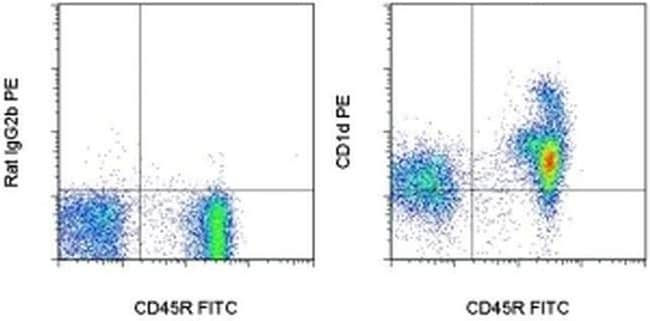
Invitrogen™ CD1d Monoclonal Antibody (1B1), PE, eBioscience™, Invitrogen™

Rat Monoclonal Antibody
172.00 CHF - 448.00 CHF
Spezifikation
| Antigen | CD1d |
|---|---|
| Klon | 1B1 |
| Konzentration | 0.2 mg/mL |
| Anwendungen | Flow Cytometry |
| Klassifikation | Monoclonal |
| Produktcode | Marke | Menge | Preis | Menge & Verfügbarkeit | |||||
|---|---|---|---|---|---|---|---|---|---|
| Produktcode | Marke | Menge | Preis | Menge & Verfügbarkeit | |||||
|
15248409
|
Invitrogen™
12-0011-81 |
50 μg |
172.00 CHF
50 Mikrogramm |
Log in om dit product te kopen Registreer vandaag om een webaccount aan te maken | |||||
|
15258409
|
Invitrogen™
12-0011-82 |
100 μg |
290.00 CHF
100 Mikrogramm |
Log in om dit product te kopen Registreer vandaag om een webaccount aan te maken | |||||
|
15268409
|
Invitrogen™
12-0011-83 |
200 μg |
448.00 CHF
200 Mikrogramm |
Log in om dit product te kopen Registreer vandaag om een webaccount aan te maken | |||||
Beschreibung
Description: The 1B1 monoclonal antibody reacts with mouse CD1d, a 48 kDa glycoprotein with structural homology to MHC class I molecules. While similar to MHC Class I, CD1d associates with beta2m, functionally CD1d is similar to MHC Class II. 1B1 detects CD1d at varying levels on mouse leukocytes. 1B1 detects beta2m associated CD1d. Applications Reported: The 1B1 antibody has been reported for use in flow cytometric analysis. Applications Tested: The 1B1 antibody has been tested by flow cytometric analysis of mouse splenocytes. This can be used at less than or equal to 0.125 μg per test. A test is defined as the amount (μg) of antibody that will stain a cell sample in a final volume of 100 μL. Cell number should be determined empirically but can range from 10^5 to 10^8 cells/test. It is recommended that the antibody be carefully titrated for optimal performance in the assay of interest. Excitation: 488-561 nm; Emission: 578 nm; Laser: Blue Laser, Green Laser, Yellow-Green Laser. Filtration: 0.2 μm post-manufacturing filtered.
CD1d is a heavy chain associated with Beta 2 microglobulin on cortical thymocytes. Beta 2 microglobulin independent expression of CD1d has also been demonstrated on human intestinal epithelial cells. CD1d is the sole group 2 member of the CD1 family of major histocompatibility (MHC) like glycoproteins. The CD1d gene encodes a divergent member of the CD1 family of transmembrane glycoproteins, which are structurally related to the major histocompatibility complex (MHC) proteins and form heterodimers with beta-2-microglobulin. The CD1 proteins mediate the presentation of primarily lipid and glycolipid antigens of self or microbial origin to T cells. The human genome contains five CD1 family genes organized in a cluster on chromosome 1. The CD1 family members are thought to differ in their cellular localization and specificity for particular lipid ligands. The protein encoded by the CD1d gene localizes to late endosomes and lysosomes via a tyrosine-based motif in the cytoplasmic tail. Diseases associated with CD1D include Mycobacterium Malmoense and Autoimmune Disease.Spezifikation
| CD1d | |
| 0.2 mg/mL | |
| Monoclonal | |
| Liquid | |
| RUO | |
| PBS with 0.09% sodium azide; pH 7.2 | |
| AI747460; Antigen-presenting glycoprotein CD1d; antigen-presenting glycoprotein CD1d1; Cd1; CD1.1; CD1A; Cd1d; CD1D antigen; CD1D antigen, d polypeptide; CD1d molecule; CD1d.1; Cd1d1; CD1d1 antigen; CD1d1 molecule; differentiation antigen CD1-alpha-3; HMC class I antigen-like glycoprotein CD1D; Ly-38; R3; R3G1; T-cell surface glycoprotein CD1d; T-cell surface glycoprotein CD1d1; thymocyte antigen CD1D | |
| Cd1d1 | |
| Primary | |
| 4°C, store in dark, DO NOT FREEZE! | |
| Cd1d1 |
| 1B1 | |
| Flow Cytometry | |
| PE | |
| Rat | |
| Mouse | |
| P11609 | |
| 12479 | |
| IgG2b κ | |
| Affinity chromatography | |
| Antibody |
For Research Use Only.
Haben Sie Verbesserungsvorschläge?Übermitteln Sie eine inhaltliche Korrektur
Berichtigung von Produktinhalten
Bitte geben Sie uns Ihr Feedback zu den Produktinhalten, indem Sie das folgende Formular ausfüllen.
Name des Produkts